Keep fake candidatesout of your pipeline.
Candidate fraud detection inside your ATS. Every application checked, every signal explained. Your team makes the call.
Candidate profiles worldwide will be fake by 2028.
Gartner, 2025Of companies say they have already hired a fake candidate at least once.
GetReal Security, 2025Reported losses from employment fraud in the US in 2024, up from $90M in 2020.
FTC, 2025US companies unknowingly hired IT workers linked to North Korea through one scheme.
US Department of Justice, 2024Your ATS sees applicants.
It doesn't see the pattern.
AI writes the resume. A borrowed identity signs it. The same template lands in twenty pipelines at once. And a real applicant hides instructions for your screening software in white text. By the time someone notices, the interview is booked and the budget is gone.
CVs that read perfectly
Generated in minutes, tuned to your job ad, clean on the surface. Keyword matching loves them. Recruiters lose hours before the first inconsistency shows up.
Identities that don't belong to the applicant
Real names, borrowed LinkedIn profiles, a stand-in on the video call. What you hire is not who you interviewed. The cost shows up in access rights, not in the recruiting budget.
Applications that come in batches
One operation, many profiles. Shared phone blocks, cloned skills sections, the same file properties across "different" people. A single CV looks fine. The cluster does not.
Every application checked.
Every signal explained.
TalentShield connects to your ATS and reviews each application as it arrives. Recruiters get an Application Integrity Score, a plain-language badge and the reasons behind it. Nothing gets rejected automatically.
Connect your ATS
Native integration or API. No new screen to learn, no change to your process. Recruiters keep working where they already work.
Each application is checked against 70+ signals
The file, the CV text, contact details and identity, and cross-checks against public data. Deterministic rules where the question is closed, AI where it is open. Results in minutes, not days.
Recruiters see the score, the badge and the reasons
Application Integrity Score from 100 down. One signal means "have a look". A cluster means "look before you book the interview". The verdict is always yours and it is always recorded as yours.
Signals with reasons.
Never verdicts.
Most tools try to score candidates. We help recruiters verify applications. Think of it like a lab result. One value off the reference range is a note for the doctor, not a diagnosis. TalentShield measures how consistent an application is with itself and with public information. Interpreting it is a human job.
The file itself
What the document says about itself. Who made it, when it was edited, and whether anything is hidden inside.
What the CV says
Patterns typical of fabricated CVs. A CV that mirrors the job ad, repeated descriptions, a version number on every skill.
Contact details and identity
Whether the details point at one real person. VoIP numbers, throwaway email domains, a name that does not match the email.
Cross-checks outside the CV
Whether the story holds up outside the file. Companies that do not exist, a CV that disagrees with LinkedIn, dead links.
Every signal carries a weight, and signals that cluster across categories count more than any single one. The result sorts your pipeline so recruiters know where to start. It never rejects anyone. What candidate fraud detection covers, from AI resumes to prompt injection.
Lives where recruiters already work.
TalentShield runs inside your ATS. Results show up next to the candidate, verification starts when an application arrives, and nobody has to remember to open another tool.
- Automatic checks per job, with per-job on and off switches
- Badge and score synced back to the candidate record in your ATS
- Candidate data stays in your ATS, TalentShield links back to it
- API for ATS vendors and job boards that want a trust layer of their own
ATSs we support today or connect through the API




Something else? We integrate through the API. Tell us in the demo form.
One click from the ATS to the TalentShield dashboard.
Day to day, recruiters stay in the ATS and have everything they need there. When someone wants the details, the dashboard has them: full reports, every signal with its evidence, decision history, and an audit trail your compliance team will actually like.
- Full verification reportsEvery signal, the evidence behind it, downloadable as PDF
- Decision historyWho reviewed what and when, recorded as a person's verdict
- Audit trailSignal version, detected signals, score and timestamp per check
- Jobs and candidates overviewVerification status per job, filters, re-verify when the library updates
Compliance isn't a feature
we added later.
Recruitment is a high-risk area under the EU AI Act. We designed for that review from day one, not after it. TalentShield is built to pass the review of your legal team, your security team and your works council.
- Human in the loop
- No automated decisionsTalentShield produces information for a recruiter to review. It does not reject, rank out or filter anyone on its own. Every recorded verdict is a person's.
- Explainability
- Every signal has a reasonRecruiters see which checks passed, which raised a flag and why. Candidates can get a meaningful explanation, as the AI Act requires.
- Data residency
- Hosted and processed in the EUApplication data is stored on EU infrastructure. AI processing runs under EU data residency, with no retention and no training on your data by model providers.
- GDPR
- Processor, not controllerYou stay the controller of candidate data. TalentShield acts as your processor under a Data Processing Agreement with a named sub-processor list.
- Audit trail
- We log what we didSignal version, detected signals, score and timestamp for every verification. Ready for a DPIA, a candidate request or an auditor.
- Minimisation
- Only what the check needsDeterministic checks run locally. Open questions go to the model with identifying data reduced to what the specific check needs. Configurable per customer.
Start with our two-page Compliance Summary: tick the box in the demo form. The Security & Architecture Overview, DPA and AI Governance Statement are ready when your legal or security team asks for them.
Built by recruiters,
for recruiters.
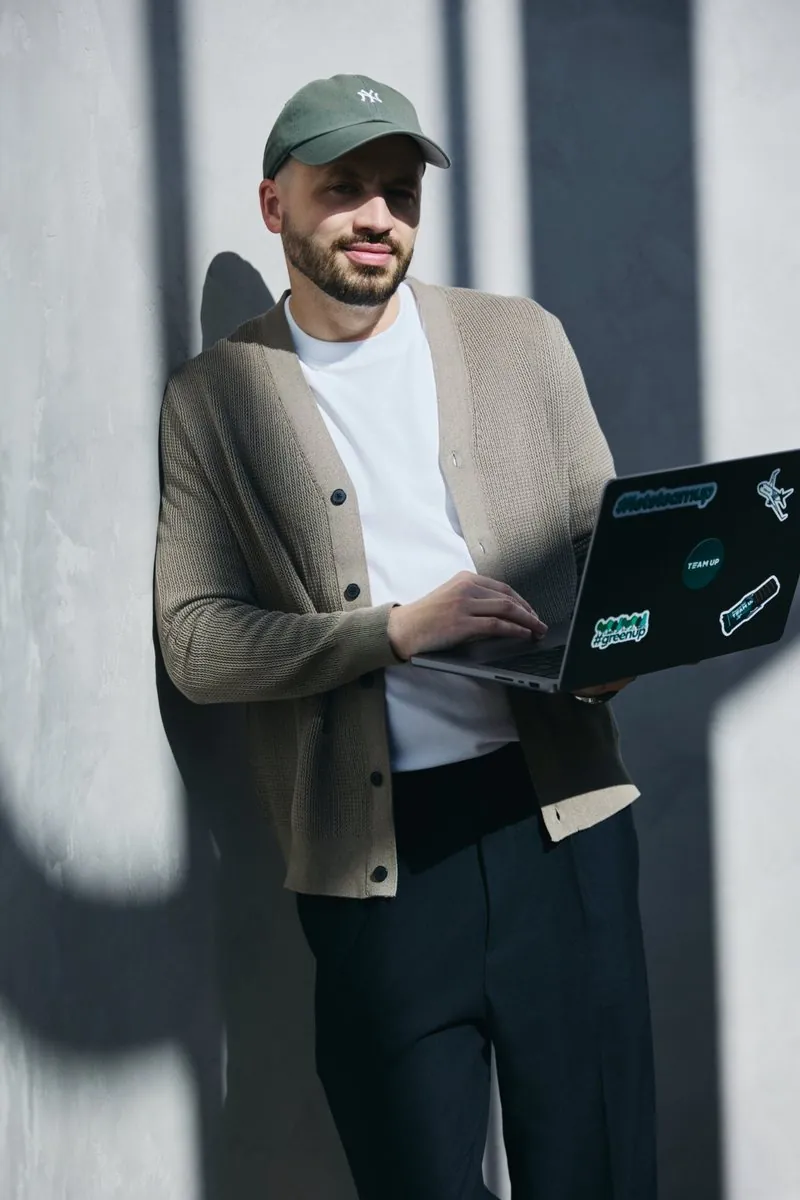
TalentShield didn't start as a search for a SaaS idea. It started in our own pipeline. We run Team Up, a technical recruitment agency, and after eighteen years of hiring for demanding clients we got hit by fake candidates on our own jobs. So we built a process for ourselves first, on our own roles, with our own team.
Turning that process into a product took an engineer who would treat it as a security problem, not a feature request. That's Bartek. He spent years building secure digital products for US companies, and he owns the architecture, the code and every integration. The three of us are equal co-founders.
"If it doesn't work in our own hiring workflow, it doesn't ship."
TalentShield runs on every application Team Up receives today. When a new fraud pattern shows up in our pipeline, it's in the signal library the same week.


Made for teams that hire at scale
and can't afford to guess.
You hire across six countries. You need recruiters to spend their time on people, not on checking whether a PDF is real.
- A second pair of eyes on every application, without slowing the team down
- Signals sorted by priority, so screening starts where it matters
- Works in the ATS your recruiters already live in
One fake candidate sent to a client costs more than a year of the tool. Your name is on every CV you forward.
- Every candidate checked before it reaches the client
- "Recruitment secured by TalentShield" as part of your offer
- One score per applicant across all your jobs, strongest signals first
Your customers keep asking what you do about fake applicants. You want an answer that doesn't take a year to build.
- API trust layer you can embed in your own product
- Explainable signals, so your customers' legal teams say yes
- A differentiator that shows up on the candidate card, not in a slide deck
You hired someone who wasn't who they said they were. The question from the board was: what did you check?
- A documented check on every application from day one
- Audit trail of what was verified, when and with which signal version
- Patterns from the incident added to the signal library, so it doesn't repeat
Questions we get from
TA leads, CTOs and legal.
No. It shows which signals it found in an application, how strong they are and what the evidence is. A recruiter reviews the evidence and records their own conclusion. There is no automatic rejection and no "fake" label produced by the system.
Usually, yes. Most patterns are visible in the application itself: file properties that don't match the person, dates that don't add up, contact data that can't be verified, a profile that differs from the CV, or a company that does not seem to exist. TalentShield checks these the moment the application arrives.
ATS screening answers "does this CV match the job?". TalentShield answers "is this application consistent with itself and with reality?". Different question, different checks. TalentShield sits next to your ATS screening and adds the layer it was never designed to provide.
Those checks tell you how an application was submitted. TalentShield checks what was submitted: the file, the CV, the contact details and how the story holds up outside the CV. As more candidates apply through their own AI agents, "submitted by automation" will describe honest applicants too. The content still has to add up.
It is designed for exactly that review. Human-in-the-loop by design, explainable signals, EU hosting and EU data residency for AI processing, a Data Processing Agreement with a named sub-processor list, and an audit trail of what the system did. We describe how it works precisely rather than stamping "compliant" on it. The two-page Compliance Summary comes with your demo request, and the full documents are available on request.
It stays yours. Application data lives in your ATS. TalentShield processes it on your instructions, stores what the verification report needs on EU infrastructure, and links back to the ATS record instead of copying it around. Model providers see reduced data, keep nothing and don't train on it.
With a supported ATS, verification runs on your first job within days of signing. We start with one or two live jobs, review results together weekly, and tune the setup to your pipeline. You see real signals on real applicants, not a demo dataset.
No, and we say so on every report. A single signal is a note to look closer. Honest people have messy CVs, gaps and odd file names. What separates a fabricated application is a cluster of signals across different categories, and that is what the score reflects.
Fake candidates 101,
written by people who hire.
What a fake candidate is, who is behind them, and what to do about it from Monday. Field notes from our own pipeline, with sources.
Five things fake applications get wrong, and the one thing they get right
Fabricated applications are built to pass keyword filters, not to survive a careful look. Five checks any recruiter can do in a minute, and why the sixth one is the trap.
What is a fake candidate? Types, real cases and what to check
A fake candidate is an applicant whose identity or experience is invented. The three types, the case that fooled us, and what to check before you hire.
Who is behind fake candidates? Operators, farms and AI-polished CVs
North Korean operators, laptop farms, AI-inflated CVs and resumes written to trick your ATS. One question sorts them, and tells you which roles are at risk.
See it on your own pipeline.
Leave your email and the ATS you use. We come back within one business day to book a 30-minute demo, on your own applicants if you want.
- Real signals on your real applicants, not a sample dataset
- Weekly review with the founders, who still recruit every day
- Compliance Summary for your legal and security teams from day one
Thanks, we've got it.
One of us will reply within one business day. In the meantime, feel free to email contact@talentshield.app.